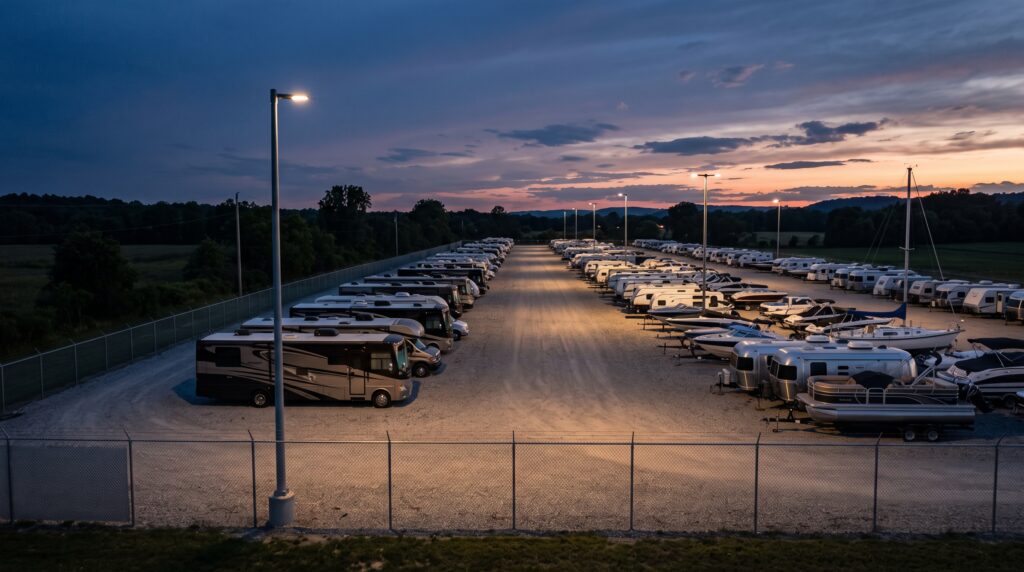
A tenant rolls up to your gate at 9 p.m. on a Friday to pull his boat for the weekend. Nobody checks him in. Nobody watches him hook up. And if a second truck slips through the gate behind him, nobody sees that either. That is the core problem of boat and RV storage security on an unstaffed lot: you are protecting some of the most expensive property your tenants own, parked in the open, with no employee on site.
Here is the part most operators get backwards. Staff never provided as much security as it felt like. A manager in the office cannot see the back row, does not work at 9 p.m. on a Friday, and spends most of the day on rentals and paperwork anyway. What the office provided was presence. Presence can be replaced, but only if you replace it deliberately, layer by layer. This post walks through those layers.
Your Gate Is Doing the Manager’s Job Now
Start where every incident starts: the entrance. On an unstaffed lot, the gate is the only thing standing between a public road and your tenants’ vehicles, so it has to do more than open and close.
Two capabilities separate a gate that secures a lot from a gate that decorates it:
- A unique code for every tenant. Shared gate codes leak. They end up with ex-tenants, brothers-in-law, and the guy who bought the boat two owners ago. A code that belongs to one person means every entry has an owner.
- Instant revoke. When a tenant moves out or sells the rig, their access should end the moment you decide it ends, from your phone. Not on your next drive out to the property.
How the gate connects matters less than it used to. Cellular keypads skip the cost of trenching internet across an open lot, which is why so many vehicle storage operators choose them. We compared the options in our post on internet vs. cellular gate access control.

Every Entry Gets a Name Attached
A camera might show you what happened. The entry log tells you whose code opened the gate.
With per-tenant codes, your access system keeps a time-stamped record of every arrival: which code, which day, what time. When a tenant calls Monday morning because a trailer jack got bent over the weekend, you are not shrugging at an empty lot. You have the code entries since Friday to work from. It will not catch a truck that tailgated in behind someone, which is exactly why the fence and the lighting still matter, but it beats starting from nothing.
Joel Melton at StorageMax in Ridgeland, Mississippi has that same record on his gates, working whether or not anyone is at the site.

The log does quieter work too. A recorded, traceable entry tends to change how people treat a lot, including the people a tenant hands a code to. Accountability is the cheapest deterrent you can add, and on an unstaffed lot it never calls in sick.
The Layers That Replace Eyes on the Lot
No single system covers an open lot, and access control does not claim to. A staffed facility got casual deterrence for free: cars in the parking lot, a light on in the office. An unstaffed facility earns the same effect with a physical stack that works while nobody watches. Fencing tall enough to mean it. Lighting on the lanes and the perimeter. Camera coverage from a reputable vendor. Posted signage stating that access is controlled and entries are logged.
We covered the physical build-out checklist in our guide to building a boat and RV storage business, so we will not rehash the specs here. The unstaffed test for every item is the same: does it deter, detect, or document without a person minding it? If a measure only works when someone responds in the moment, it belongs at a staffed site, not yours.
What Still Needs a Human
Remote security does not mean zero visits, and operators who pretend otherwise learn it the expensive way. Fences sag. Storms drop limbs across them. Gate hardware wears out mid-lease, lamps burn out, and cameras drift out of aim. None of that announces itself remotely until it fails at the worst time.
The fix is a scheduled walk-through with a short checklist: fence line, lighting, gate cycle, camera views, signage. Monthly is a reasonable floor, weekly if the lot is remote or the rigs are expensive, and tighter after storms or an incident. The unstaffed model does not eliminate human presence. It converts presence from a payroll line into a scheduled task with a purpose.
This Is Not Just a Rural Play
Plenty of boat and RV storage sits behind a suburban business park, not at the end of a county road, and the unstaffed security model is the same in both places. Unique codes, entry logs, layered deterrence, scheduled visits.
Where the sites differ is connectivity. Rural lots often cannot get reliable internet at the gate, which is where cellular keypads stop being a preference and become the only practical option. Suburban lots usually choose cellular anyway, to skip the trenching, the modem in a weatherproof box, and the outage calls. Either way, the security layer should not depend on the most fragile utility on the property.
Run the Lot Like the Gate Works for You
Securing an unstaffed boat and RV facility comes down to making every layer answer one question: what did the on-site person used to do, and what does it now? The gate filters who enters. The log remembers. The fence, lights, and cameras deter. The walk-through catches wear before it becomes an incident. Set those layers up once, and you get a lot that protects tenant property around the clock without carrying an office to do it.
If the gate is the layer you are missing, start with our self-storage access control keypads, including cellular models built for lots exactly like yours. And if you want the operations side of the same story, read our companion post on boat and RV storage management.